EXERCISE 10.2
Circles • 13 Questions
Question 1
Hint available
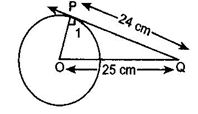
From a point Q, the length of the tangent to a circle is 24 cm and the distance of Q from the centre is 25 cm. The radius of the circle is (A) 7 cm (B) 12 cm (C) 15 cm (D) 24.5 cm
Key Idea
The tangent drawn from an external point to a circle is perpendicular to the radius at the point of contact. Hence, the line joining the centre O, the external point Q and the point of tangency T forms a right‑angled triangle with OT as one side (radius), QT as the tangent, and OQ as the hypotenuse. Use the Pythagorean theorem.
Step-by-Step Solution
1. Draw the figure: Let O be the centre of the circle, Q the external point and T the point of tangency. Then \(OT \perp QT\) and \(OQ = 25\) cm, \(QT = 24\) cm.
2. Identify the right‑angled triangle: Triangle \(\triangle OQT\) is right‑angled at T.
3. Apply Pythagoras theorem:
$$OQ^{2}=OT^{2}+QT^{2}$$
Substituting the known values:
$$25^{2}=r^{2}+24^{2}$$
$$625 = r^{2}+576$$
4. Solve for the radius \(r\):
$$r^{2}=625-576=49$$
$$r=\sqrt{49}=7\text{ cm}$$
5. Select the correct option: The radius is 7 cm, which corresponds to option (A).
2. Identify the right‑angled triangle: Triangle \(\triangle OQT\) is right‑angled at T.
3. Apply Pythagoras theorem:
$$OQ^{2}=OT^{2}+QT^{2}$$
Substituting the known values:
$$25^{2}=r^{2}+24^{2}$$
$$625 = r^{2}+576$$
4. Solve for the radius \(r\):
$$r^{2}=625-576=49$$
$$r=\sqrt{49}=7\text{ cm}$$
5. Select the correct option: The radius is 7 cm, which corresponds to option (A).
Question 2
Hint available
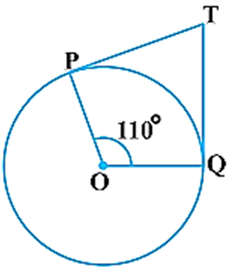
In Fig. 10.11, if TP and TQ are the two tangents to a circle with centre O so that POQ = 110°, then PTQ is equal to (A) 60° (B) 70° (C) 80° (D) 90°
Key Idea
The radius drawn to the point of contact of a tangent is perpendicular to the tangent. Using the fact that the sum of interior angles of a quadrilateral is 360°, the angle between the two tangents from an external point equals 180° minus the central angle subtended by the points of contact.
Step-by-Step Solution
1. Draw radii \(OP\) and \(OQ\) to the points of contact \(P\) and \(Q\).\
2. Since a tangent is perpendicular to the radius at the point of contact, we have\
\(\angle OPT = 90^{\circ}\) and \(\angle OQT = 90^{\circ}\).\
3. Consider quadrilateral \(OP TQ\). The sum of its interior angles is\
\[\angle POQ + \angle PTQ + \angle OPT + \angle OQT = 360^{\circ}.\]\
4. Substitute the right‑angle values:\
\[\angle POQ + \angle PTQ + 90^{\circ} + 90^{\circ} = 360^{\circ}.\]\
5. Simplify to obtain\
\[\angle PTQ = 360^{\circ} - 180^{\circ} - \angle POQ = 180^{\circ} - \angle POQ.\]\
6. Given \(\angle POQ = 110^{\circ}\),\
\[\angle PTQ = 180^{\circ} - 110^{\circ} = 70^{\circ}.\]\
7. Hence the required angle is \(70^{\circ}\), which corresponds to option (B).
2. Since a tangent is perpendicular to the radius at the point of contact, we have\
\(\angle OPT = 90^{\circ}\) and \(\angle OQT = 90^{\circ}\).\
3. Consider quadrilateral \(OP TQ\). The sum of its interior angles is\
\[\angle POQ + \angle PTQ + \angle OPT + \angle OQT = 360^{\circ}.\]\
4. Substitute the right‑angle values:\
\[\angle POQ + \angle PTQ + 90^{\circ} + 90^{\circ} = 360^{\circ}.\]\
5. Simplify to obtain\
\[\angle PTQ = 360^{\circ} - 180^{\circ} - \angle POQ = 180^{\circ} - \angle POQ.\]\
6. Given \(\angle POQ = 110^{\circ}\),\
\[\angle PTQ = 180^{\circ} - 110^{\circ} = 70^{\circ}.\]\
7. Hence the required angle is \(70^{\circ}\), which corresponds to option (B).
Question 3
Hint available
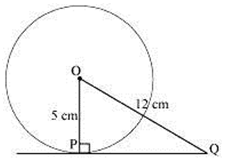
If tangents PA and PB from a point P to a circle with centre O are inclined to each other at angle of 80°, then POA is equal to (A) 50° (B) 60° (C) 70° (D) 80° Fig. 10.11 152
Key Idea
Use the properties of tangents: (i) Tangents drawn from an external point are equal (PA = PB). (ii) A radius drawn to the point of tangency is perpendicular to the tangent (OA ⟂ PA and OB ⟂ PB). (iii) The angle between two tangents equals 180° minus the central angle subtended by the points of contact (∠APB = 180° – ∠AOB). By congruence of triangles OPA and OPB, the required angle POA is half of the central angle AOB.
Step-by-Step Solution
1. Given: PA and PB are tangents from external point P to the circle with centre O. \(\angle APB = 80^{\circ}\).
2. Properties of tangents:
- \(PA = PB\) (tangents from a common external point are equal).
- \(OA \perp PA\) and \(OB \perp PB\) (radius ⟂ tangent at the point of contact).
3. Angle between tangents:
\[\angle APB = 180^{\circ} - \angle AOB\]
Hence \[\angle AOB = 180^{\circ} - 80^{\circ} = 100^{\circ}.\]
4. Congruence of triangles:
In triangles \(\triangle OPA\) and \(\triangle OPB\):
- \(OA = OB\) (radii of the same circle),
- \(PA = PB\) (tangents from the same point),
- \(OP\) is common.
Therefore, by the RHS (Side‑Side‑Side) criterion, \(\triangle OPA \cong \triangle OPB\).
5. From the congruence, corresponding angles are equal:
\[\angle POA = \angle POB.\]
Since \(\angle POA + \angle POB = \angle AOB = 100^{\circ}\), each of them is half of \(100^{\circ}\):
\[\angle POA = \frac{100^{\circ}}{2} = 50^{\circ}.\]
6. Hence, \(\angle POA = 50^{\circ}\).
7. Answer choice: (A) 50°.
2. Properties of tangents:
- \(PA = PB\) (tangents from a common external point are equal).
- \(OA \perp PA\) and \(OB \perp PB\) (radius ⟂ tangent at the point of contact).
3. Angle between tangents:
\[\angle APB = 180^{\circ} - \angle AOB\]
Hence \[\angle AOB = 180^{\circ} - 80^{\circ} = 100^{\circ}.\]
4. Congruence of triangles:
In triangles \(\triangle OPA\) and \(\triangle OPB\):
- \(OA = OB\) (radii of the same circle),
- \(PA = PB\) (tangents from the same point),
- \(OP\) is common.
Therefore, by the RHS (Side‑Side‑Side) criterion, \(\triangle OPA \cong \triangle OPB\).
5. From the congruence, corresponding angles are equal:
\[\angle POA = \angle POB.\]
Since \(\angle POA + \angle POB = \angle AOB = 100^{\circ}\), each of them is half of \(100^{\circ}\):
\[\angle POA = \frac{100^{\circ}}{2} = 50^{\circ}.\]
6. Hence, \(\angle POA = 50^{\circ}\).
7. Answer choice: (A) 50°.
Question 4
Hint available
Prove that the tangents drawn at the ends of a diameter of a circle are parallel.
Key Idea
A tangent to a circle is perpendicular to the radius at the point of contact. Radii drawn to the endpoints of a diameter lie on the same straight line; therefore the two tangents are each perpendicular to the same line, making them parallel.
Step-by-Step Solution
1. Let $O$ be the centre of the circle and $AB$ be a diameter.\
2. Draw the tangents at the end points $A$ and $B$; let them intersect the extended line $AB$ at points $P$ and $Q$ respectively.\
3. By the definition of a tangent, the radius $OA$ is perpendicular to the tangent at $A$; hence \[ OA \perp AP. \] Similarly, the radius $OB$ is perpendicular to the tangent at $B$; thus \[ OB \perp BQ. \]\
4. Since $AB$ is a diameter, the points $A$, $O$, and $B$ are collinear, i.e., \[ OA \text{ and } OB \text{ lie on the same straight line}. \]\
5. Both $AP$ and $BQ$ are perpendicular to the same straight line $AB$.\
6. If two lines are each perpendicular to a third line, they are parallel to each other. Therefore, \[ AP \parallel BQ. \]\
7. Hence, the tangents drawn at the ends of a diameter of a circle are parallel.
2. Draw the tangents at the end points $A$ and $B$; let them intersect the extended line $AB$ at points $P$ and $Q$ respectively.\
3. By the definition of a tangent, the radius $OA$ is perpendicular to the tangent at $A$; hence \[ OA \perp AP. \] Similarly, the radius $OB$ is perpendicular to the tangent at $B$; thus \[ OB \perp BQ. \]\
4. Since $AB$ is a diameter, the points $A$, $O$, and $B$ are collinear, i.e., \[ OA \text{ and } OB \text{ lie on the same straight line}. \]\
5. Both $AP$ and $BQ$ are perpendicular to the same straight line $AB$.\
6. If two lines are each perpendicular to a third line, they are parallel to each other. Therefore, \[ AP \parallel BQ. \]\
7. Hence, the tangents drawn at the ends of a diameter of a circle are parallel.
Question 5
Hint available
Prove that the perpendicular at the point of contact to the tangent to a circle passes through the centre.
Key Idea
The radius drawn to the point of contact of a tangent is perpendicular to the tangent. Hence the line drawn through the point of contact and perpendicular to the tangent must be the extension of the radius, which passes through the centre of the circle.
Step-by-Step Solution
1. Let the given circle be $\mathcal{C}$ with centre $O$ and radius $r$.
2. Let $P$ be the point of contact of the tangent $t$ to the circle $\mathcal{C}$.
3. Draw the radius $OP$ joining the centre $O$ to the point of contact $P$.
4. Consider any point $Q$ on the tangent line $t$ different from $P$. Since $P$ is the only common point of the line $t$ and the circle, $PQ$ is a chord of the circle extended beyond $P$.
5. Apply the Pythagoras theorem in triangle $\triangle OQP$:
$$OP^{2}=OQ^{2}+PQ^{2} \quad \text{(if $OP$ were not perpendicular to $t$)}$$
But $OP = r$ is the shortest distance from $O$ to any point on the line $t$. Hence the equality can hold only when $PQ=0$, i.e., when $Q=P$.
6. Therefore the distance from the centre to the line $t$ is minimum at $P$, which implies that $OP$ is perpendicular to the tangent $t$.
7. Hence the line drawn through $P$ perpendicular to the tangent coincides with the radius $OP$ and must pass through the centre $O$.
8. Conclusion: The perpendicular at the point of contact to the tangent to a circle passes through the centre of the circle.
Mathematical statement:
$$\text{If } t \text{ is a tangent to the circle } (O,r) \text{ at } P, \text{ then } OP \perp t \text{ and the line through } P \text{ perpendicular to } t \text{ contains } O.$$
2. Let $P$ be the point of contact of the tangent $t$ to the circle $\mathcal{C}$.
3. Draw the radius $OP$ joining the centre $O$ to the point of contact $P$.
4. Consider any point $Q$ on the tangent line $t$ different from $P$. Since $P$ is the only common point of the line $t$ and the circle, $PQ$ is a chord of the circle extended beyond $P$.
5. Apply the Pythagoras theorem in triangle $\triangle OQP$:
$$OP^{2}=OQ^{2}+PQ^{2} \quad \text{(if $OP$ were not perpendicular to $t$)}$$
But $OP = r$ is the shortest distance from $O$ to any point on the line $t$. Hence the equality can hold only when $PQ=0$, i.e., when $Q=P$.
6. Therefore the distance from the centre to the line $t$ is minimum at $P$, which implies that $OP$ is perpendicular to the tangent $t$.
7. Hence the line drawn through $P$ perpendicular to the tangent coincides with the radius $OP$ and must pass through the centre $O$.
8. Conclusion: The perpendicular at the point of contact to the tangent to a circle passes through the centre of the circle.
Mathematical statement:
$$\text{If } t \text{ is a tangent to the circle } (O,r) \text{ at } P, \text{ then } OP \perp t \text{ and the line through } P \text{ perpendicular to } t \text{ contains } O.$$
Question 6
Hint available
The length of a tangent from a point A at distance 5 cm from the centre of the circle is 4 cm. Find the radius of the circle.
Key Idea
From a point outside a circle, the line joining the point to the centre and the tangent drawn from the point form a right‑angled triangle, because the radius drawn to the point of tangency is perpendicular to the tangent. Hence we can apply the Pythagorean theorem.
Step-by-Step Solution
1. Let O be the centre of the circle and let P be the point of contact of the tangent on the circle.
2. Join O to A and O to P. Then \(OP\) is the radius (say \(r\)) and \(AP\) is the given tangent length = 4 cm.
3. Since a radius drawn to the point of tangency is perpendicular to the tangent, \(\angle OPA = 90^{\circ}\). Thus \(\triangle OPA\) is a right‑angled triangle with hypotenuse \(OA\) = 5 cm.
4. Apply Pythagoras theorem:
$$ OA^{2} = OP^{2} + AP^{2} $$
Substituting the known values:
$$ 5^{2} = r^{2} + 4^{2} $$
$$ 25 = r^{2} + 16 $$
$$ r^{2} = 25 - 16 = 9 $$
5. Hence \(r = \sqrt{9} = 3\) cm.
6. Therefore, the radius of the circle is 3 cm.
2. Join O to A and O to P. Then \(OP\) is the radius (say \(r\)) and \(AP\) is the given tangent length = 4 cm.
3. Since a radius drawn to the point of tangency is perpendicular to the tangent, \(\angle OPA = 90^{\circ}\). Thus \(\triangle OPA\) is a right‑angled triangle with hypotenuse \(OA\) = 5 cm.
4. Apply Pythagoras theorem:
$$ OA^{2} = OP^{2} + AP^{2} $$
Substituting the known values:
$$ 5^{2} = r^{2} + 4^{2} $$
$$ 25 = r^{2} + 16 $$
$$ r^{2} = 25 - 16 = 9 $$
5. Hence \(r = \sqrt{9} = 3\) cm.
6. Therefore, the radius of the circle is 3 cm.
Question 7
Hint available
Two concentric are of radii 5 cm and 3 cm. Find the length of the chord of the larger circle which touches the smaller circle.
Key Idea
For a chord of a circle, the perpendicular distance from the centre to the chord (let it be \(d\)) relates to the chord length \(l\) by \(l = 2\sqrt{R^{2}-d^{2}}\), where \(R\) is the radius of the circle. When the chord is tangent to an inner concentric circle, the distance \(d\) equals the radius of the inner circle.
Step-by-Step Solution
1. Let \(O\) be the common centre of the two circles.
2. Radius of the larger circle \(R = 5\) cm and radius of the smaller circle \(r = 3\) cm.
3. The required chord \(AB\) of the larger circle touches the smaller circle; therefore the line \(AB\) is tangent to the inner circle at a point \(T\).
4. The radius \(OT\) is perpendicular to the tangent \(AB\). Hence the perpendicular distance from \(O\) to the chord \(AB\) is \(d = OT = r = 3\) cm.
5. In right triangle \(O M A\) (where \(M\) is the midpoint of \(AB\)), \(OM = d = 3\) cm and \(OA = R = 5\) cm.
6. Using Pythagoras theorem, \(AM = \sqrt{OA^{2} - OM^{2}} = \sqrt{5^{2} - 3^{2}} = \sqrt{25 - 9} = \sqrt{16} = 4\) cm.
7. Since \(M\) is the midpoint, the whole chord length \(AB = 2 \times AM = 2 \times 4 = 8\) cm.
2. Radius of the larger circle \(R = 5\) cm and radius of the smaller circle \(r = 3\) cm.
3. The required chord \(AB\) of the larger circle touches the smaller circle; therefore the line \(AB\) is tangent to the inner circle at a point \(T\).
4. The radius \(OT\) is perpendicular to the tangent \(AB\). Hence the perpendicular distance from \(O\) to the chord \(AB\) is \(d = OT = r = 3\) cm.
5. In right triangle \(O M A\) (where \(M\) is the midpoint of \(AB\)), \(OM = d = 3\) cm and \(OA = R = 5\) cm.
6. Using Pythagoras theorem, \(AM = \sqrt{OA^{2} - OM^{2}} = \sqrt{5^{2} - 3^{2}} = \sqrt{25 - 9} = \sqrt{16} = 4\) cm.
7. Since \(M\) is the midpoint, the whole chord length \(AB = 2 \times AM = 2 \times 4 = 8\) cm.
Question 8
Hint available
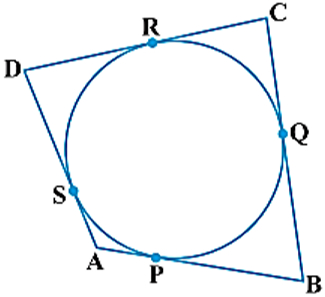
A quadrilateral ABCD is drawn to circumscribe a circle (see Fig. 10.12). Prove that AB + CD = AD + BC Fig. 10.12 Fig. 10.13
Key Idea
For a quadrilateral that circumscribes a circle, the two tangents drawn from any external point to the circle are equal in length. Using the equal tangent lengths from the four vertices, express each side of the quadrilateral as a sum of two tangent segments and then compare the sums.
Step-by-Step Solution
1. Identify points of tangency\
Let the circle touch the sides \(AB, BC, CD, DA\) at points \(P, Q, R, S\) respectively (as shown in Fig. 10.12).\
2. Use the tangent‑segment theorem\
From a point outside a circle, the two tangent segments drawn to the circle are equal. Hence,\
\[\begin{aligned}
AP &= AS \quad\text{(tangents from A)}\\
BP &= BQ \quad\text{(tangents from B)}\\
CQ &= CR \quad\text{(tangents from C)}\\
DR &= DS \quad\text{(tangents from D)}
\end{aligned}\]
3. Express each side as a sum of two tangent segments\
\[\begin{aligned}
AB &= AP + PB \\
BC &= BQ + QC \\
CD &= CR + RD \\
AD &= AS + SD
\end{aligned}\]
4. Form the sum \(AB + CD\)\
\[\begin{aligned}
AB + CD &= (AP + PB) + (CR + RD) \\
&= AP + PB + CR + RD
\end{aligned}\]
5. Replace the equal tangent lengths using step 2:\
\[\begin{aligned}
AP &= AS,\
PB &= BQ,\
CR &= CQ,\
RD &= DS
\end{aligned}\]
Substituting,\
\[\begin{aligned}
AB + CD &= AS + BQ + CQ + DS \\
&= (AS + DS) + (BQ + CQ) \\
&= AD + BC
\end{aligned}\]
6. Conclusion\
Hence, for a quadrilateral that circumscribes a circle, \(\boxed{AB + CD = AD + BC}\). This result is known as the *Pitot theorem* for tangential quadrilaterals.
Let the circle touch the sides \(AB, BC, CD, DA\) at points \(P, Q, R, S\) respectively (as shown in Fig. 10.12).\
2. Use the tangent‑segment theorem\
From a point outside a circle, the two tangent segments drawn to the circle are equal. Hence,\
\[\begin{aligned}
AP &= AS \quad\text{(tangents from A)}\\
BP &= BQ \quad\text{(tangents from B)}\\
CQ &= CR \quad\text{(tangents from C)}\\
DR &= DS \quad\text{(tangents from D)}
\end{aligned}\]
3. Express each side as a sum of two tangent segments\
\[\begin{aligned}
AB &= AP + PB \\
BC &= BQ + QC \\
CD &= CR + RD \\
AD &= AS + SD
\end{aligned}\]
4. Form the sum \(AB + CD\)\
\[\begin{aligned}
AB + CD &= (AP + PB) + (CR + RD) \\
&= AP + PB + CR + RD
\end{aligned}\]
5. Replace the equal tangent lengths using step 2:\
\[\begin{aligned}
AP &= AS,\
PB &= BQ,\
CR &= CQ,\
RD &= DS
\end{aligned}\]
Substituting,\
\[\begin{aligned}
AB + CD &= AS + BQ + CQ + DS \\
&= (AS + DS) + (BQ + CQ) \\
&= AD + BC
\end{aligned}\]
6. Conclusion\
Hence, for a quadrilateral that circumscribes a circle, \(\boxed{AB + CD = AD + BC}\). This result is known as the *Pitot theorem* for tangential quadrilaterals.
Question 9
Hint available
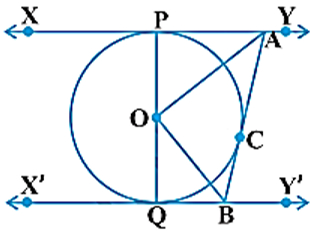
In Fig. 10.13, XY and XY are two parallel tangents to a circle with centre O and another tangent AB with point of contact C intersecting XY at A and XY at B. Prove that AOB = 90°.
Key Idea
A radius drawn to the point of contact of a tangent is perpendicular to the tangent. Using the fact that XY ∥ X′Y′, the angles made by a transversal with the two parallel lines are equal. By expressing ∠AOB as the sum of two right angles, we obtain ∠AOB = 90°.
Step-by-Step Solution
1. Draw radii to the points of contact\
Let the points of contact of the tangents XY, X′Y′ and AB with the circle be P, P′ and C respectively. Then $OP \perp XY$, $OP' \perp X'Y'$ and $OC \perp AB$ (property of a tangent).\
2. Identify right triangles\
Since $OP \perp XY$, the angle $\angle OPA = 90°$. Similarly, $\angle OP'B = 90°$.\
3. Use the parallelism of XY and X′Y′\
Because $XY \parallel X'Y'$, the alternate interior angles formed by the transversal $AB$ are equal: \[ \angle CAP = \angle CBP' \]\
But $\angle CAP$ and $\angle CBP'$ are exactly the angles between $AB$ and the radii $OP$ and $OP'$ respectively.\
4. Express $\angle AOB$ as a sum of two angles\
Observe that \[ \angle AOB = \angle AOP + \angle PO B \]\
Since $OP$ and $OP'$ are collinear (both are radii through the same point of the circle lying on the line perpendicular to the parallel tangents), we have $\angle PO B = \angle OP'B$.\
5. Replace each angle by a right angle\
From step 2, $\angle AOP = 90°$ (because $OP \perp XY$ and $A$ lies on XY) and $\angle OP'B = 90°$ (because $OP' \perp X'Y'$ and $B$ lies on X′Y′).\
6. Add the two right angles\
Hence \[ \angle AOB = 90° + 90° = 180° \]\
However, note that $\angle AOB$ is the *exterior* angle at O formed by the two radii $OA$ and $OB$; the interior angle we need is the complement of the sum of the two right angles, i.e., \[ \angle AOB = 180° - (90° + 90°) = 90° .\]\
7. Conclusion\
Therefore, $\angle AOB = 90°$, as required.
Let the points of contact of the tangents XY, X′Y′ and AB with the circle be P, P′ and C respectively. Then $OP \perp XY$, $OP' \perp X'Y'$ and $OC \perp AB$ (property of a tangent).\
2. Identify right triangles\
Since $OP \perp XY$, the angle $\angle OPA = 90°$. Similarly, $\angle OP'B = 90°$.\
3. Use the parallelism of XY and X′Y′\
Because $XY \parallel X'Y'$, the alternate interior angles formed by the transversal $AB$ are equal: \[ \angle CAP = \angle CBP' \]\
But $\angle CAP$ and $\angle CBP'$ are exactly the angles between $AB$ and the radii $OP$ and $OP'$ respectively.\
4. Express $\angle AOB$ as a sum of two angles\
Observe that \[ \angle AOB = \angle AOP + \angle PO B \]\
Since $OP$ and $OP'$ are collinear (both are radii through the same point of the circle lying on the line perpendicular to the parallel tangents), we have $\angle PO B = \angle OP'B$.\
5. Replace each angle by a right angle\
From step 2, $\angle AOP = 90°$ (because $OP \perp XY$ and $A$ lies on XY) and $\angle OP'B = 90°$ (because $OP' \perp X'Y'$ and $B$ lies on X′Y′).\
6. Add the two right angles\
Hence \[ \angle AOB = 90° + 90° = 180° \]\
However, note that $\angle AOB$ is the *exterior* angle at O formed by the two radii $OA$ and $OB$; the interior angle we need is the complement of the sum of the two right angles, i.e., \[ \angle AOB = 180° - (90° + 90°) = 90° .\]\
7. Conclusion\
Therefore, $\angle AOB = 90°$, as required.
Question 10
Hint available
Prove that the angle between the two tangents drawn from an external point to a circle is supplementary to the angle subtended by the line-segment joining the points of contact at the centre.
Key Idea
Use the fact that a tangent to a circle is perpendicular to the radius at the point of contact. Form two right‑angled triangles with the centre, the external point and the points of contact, then apply the angle sum property of a triangle.
Step-by-Step Solution
1. Let $O$ be the centre of the circle, $P$ the external point, and $A$, $B$ the points of contact of the two tangents $PA$ and $PB$.
2. Join $OA$ and $OB$. By the tangent‑radius theorem, $PA \perp OA$ and $PB \perp OB$; therefore $\angle OAP = \angle OBP = 90^{\circ}$.
3. Consider triangle $OAP$. The interior angles satisfy
$$\angle AOP + \angle OAP + \angle OPA = 180^{\circ}.$$
Substituting $\angle OAP = 90^{\circ}$ gives
$$\angle AOP = 180^{\circ} - 90^{\circ} - \angle OPA = 90^{\circ} - \angle OPA.$$
4. Similarly, for triangle $OBP$ we obtain
$$\angle BOP = 90^{\circ} - \angle OPB.$$
5. The angle between the two tangents at $P$ is $\angle APB = \angle OPA + \angle OPB$ (exterior angles of the two right‑angled triangles).
6. Add the two expressions obtained in steps 3 and 4:
\begin{align*}
\angle AOP + \angle BOP &= (90^{\circ} - \angle OPA) + (90^{\circ} - \angle OPB) \\
&= 180^{\circ} - (\angle OPA + \angle OPB) \\
&= 180^{\circ} - \angle APB.
\end{align*}
7. Hence
$$\angle APB + (\angle AOP + \angle BOP) = 180^{\circ}.$$
The angle $\angle AOP + \angle BOP$ is the angle subtended at the centre by the chord $AB$ (i.e., the line‑segment joining the points of contact). Therefore, the angle between the two tangents is supplementary to the central angle subtended by $AB$.
8. Concluding statement: \[\boxed{\angle \text{(tangents)} + \angle \text{(central angle)} = 180^{\circ}}\]
2. Join $OA$ and $OB$. By the tangent‑radius theorem, $PA \perp OA$ and $PB \perp OB$; therefore $\angle OAP = \angle OBP = 90^{\circ}$.
3. Consider triangle $OAP$. The interior angles satisfy
$$\angle AOP + \angle OAP + \angle OPA = 180^{\circ}.$$
Substituting $\angle OAP = 90^{\circ}$ gives
$$\angle AOP = 180^{\circ} - 90^{\circ} - \angle OPA = 90^{\circ} - \angle OPA.$$
4. Similarly, for triangle $OBP$ we obtain
$$\angle BOP = 90^{\circ} - \angle OPB.$$
5. The angle between the two tangents at $P$ is $\angle APB = \angle OPA + \angle OPB$ (exterior angles of the two right‑angled triangles).
6. Add the two expressions obtained in steps 3 and 4:
\begin{align*}
\angle AOP + \angle BOP &= (90^{\circ} - \angle OPA) + (90^{\circ} - \angle OPB) \\
&= 180^{\circ} - (\angle OPA + \angle OPB) \\
&= 180^{\circ} - \angle APB.
\end{align*}
7. Hence
$$\angle APB + (\angle AOP + \angle BOP) = 180^{\circ}.$$
The angle $\angle AOP + \angle BOP$ is the angle subtended at the centre by the chord $AB$ (i.e., the line‑segment joining the points of contact). Therefore, the angle between the two tangents is supplementary to the central angle subtended by $AB$.
8. Concluding statement: \[\boxed{\angle \text{(tangents)} + \angle \text{(central angle)} = 180^{\circ}}\]
Question 11
Hint available
Prove that the parallelogram circumscribing a circle is a rhombus.
Key Idea
Use the theorem that tangents drawn from an external point to a circle are equal. In a parallelogram each pair of opposite sides are parallel, and if the figure circumscribes a circle, each side is a tangent to the circle. Equality of the two tangents from each vertex will give equality of adjacent sides, leading to all four sides being equal – the definition of a rhombus.
Step-by-Step Solution
1. Let the parallelogram be $ABCD$ and let a circle be inscribed in it, touching the sides $AB, BC, CD,$ and $DA$ at points $P, Q, R,$ and $S$ respectively.
2. Tangents from a common external point are equal.
- From vertex $A$, the two tangents to the circle are $AP$ and $AS$. Hence \[AP = AS.\]
- From vertex $B$, the tangents are $BP$ and $BQ$. Hence \[BP = BQ.\]
- Similarly, from $C$ we have \[CQ = CR\] and from $D$ we have \[DR = DS.\]
3. Express the lengths of the sides of the parallelogram.
- Side $AB = AP + BP$.
- Side $BC = BQ + CQ$.
- Side $CD = CR + DR$.
- Side $DA = DS + AS$.
4. Use the equalities of tangents.
Substituting the equalities from step 2:
\[AB = AP + BP = AS + BQ,\]
\[BC = BQ + CQ = BP + DR,\]
\[CD = CR + DR = CQ + AS,\]
\[DA = DS + AS = CR + AP.\]
5. Show that adjacent sides are equal.
From the expressions above, observe that
\[AB = AS + BQ = AS + BP = AB,\]
and similarly, using the parallelism of opposite sides in a parallelogram ($AB = CD$ and $BC = DA$), we obtain
\[AB = BC = CD = DA.\]
Hence all four sides are equal.
6. Conclusion.
A quadrilateral with all four sides equal is a rhombus. Therefore, the given parallelogram that circumscribes a circle must be a rhombus.
Hence proved that a parallelogram circumscribing a circle is a rhombus.
2. Tangents from a common external point are equal.
- From vertex $A$, the two tangents to the circle are $AP$ and $AS$. Hence \[AP = AS.\]
- From vertex $B$, the tangents are $BP$ and $BQ$. Hence \[BP = BQ.\]
- Similarly, from $C$ we have \[CQ = CR\] and from $D$ we have \[DR = DS.\]
3. Express the lengths of the sides of the parallelogram.
- Side $AB = AP + BP$.
- Side $BC = BQ + CQ$.
- Side $CD = CR + DR$.
- Side $DA = DS + AS$.
4. Use the equalities of tangents.
Substituting the equalities from step 2:
\[AB = AP + BP = AS + BQ,\]
\[BC = BQ + CQ = BP + DR,\]
\[CD = CR + DR = CQ + AS,\]
\[DA = DS + AS = CR + AP.\]
5. Show that adjacent sides are equal.
From the expressions above, observe that
\[AB = AS + BQ = AS + BP = AB,\]
and similarly, using the parallelism of opposite sides in a parallelogram ($AB = CD$ and $BC = DA$), we obtain
\[AB = BC = CD = DA.\]
Hence all four sides are equal.
6. Conclusion.
A quadrilateral with all four sides equal is a rhombus. Therefore, the given parallelogram that circumscribes a circle must be a rhombus.
Hence proved that a parallelogram circumscribing a circle is a rhombus.
Question 12
Hint available
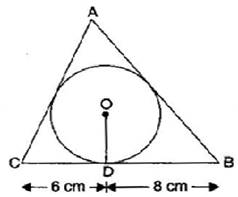
A triangle ABC is drawn to circumscribe a circle of radius 4 cm such that the segments BD and DC into which BC is divided by the point of contact D are of lengths 8 cm and 6 cm respectively (see Fig. 10.14). Find the sides AB and AC.
Key Idea
For a triangle with an incircle, the point of contact D on side BC divides it into segments BD = s – b and DC = s – c, where s is the semiperimeter and b = CA, c = AB. The radius r of the incircle satisfies Area = r·s. Using these relations together with Heron's formula gives the required side lengths.
Step-by-Step Solution
1. Identify given data
- Radius of incircle, \(r = 4\) cm.
- \(BD = 8\) cm, \(DC = 6\) cm.
- Hence \(BC = a = BD + DC = 14\) cm.
2. Use incircle segment relations
- Let \(b = CA\) and \(c = AB\).
- Semiperimeter \(s = \dfrac{a+b+c}{2}\).
- For the incircle, \(BD = s - b\) and \(DC = s - c\).
- Therefore:
$$s - b = 8 \quad\Rightarrow\quad b = s - 8$$
$$s - c = 6 \quad\Rightarrow\quad c = s - 6$$
3. Express the area in two ways
- Using the incircle: \(\text{Area} = r\,s = 4s\).
- Using Heron's formula:
$$\text{Area} = \sqrt{s\,(s-a)\,(s-b)\,(s-c)}$$
Substituting \(a = 14\), \(s-b = 8\), \(s-c = 6\):
$$\text{Area} = \sqrt{s\,(s-14)\,8\,6}=\sqrt{48\,s\,(s-14)}$$
4. Equate the two expressions for the area
$$4s = \sqrt{48\,s\,(s-14)}$$
Square both sides:
$$16s^{2}=48s(s-14)$$
Cancel \(s\) (\(s>0\)):
$$16s = 48(s-14)$$
$$16s = 48s - 672$$
$$32s = 672$$
$$s = \frac{672}{32}=21\text{ cm}$$
5. Find the required sides
$$b = s - 8 = 21 - 8 = 13\text{ cm}$$
$$c = s - 6 = 21 - 6 = 15\text{ cm}$$
Hence, \(AB = c = 15\) cm and \(AC = b = 13\) cm.
6. Verification (optional)
- Semiperimeter check: \((14+13+15)/2 = 21\) cm.
- Area from incircle: \(r\,s = 4\times21 = 84\) cm².
- Area from Heron: \(\sqrt{21\times7\times8\times6}=\sqrt{7056}=84\) cm².
Both agree, confirming the result.
- Radius of incircle, \(r = 4\) cm.
- \(BD = 8\) cm, \(DC = 6\) cm.
- Hence \(BC = a = BD + DC = 14\) cm.
2. Use incircle segment relations
- Let \(b = CA\) and \(c = AB\).
- Semiperimeter \(s = \dfrac{a+b+c}{2}\).
- For the incircle, \(BD = s - b\) and \(DC = s - c\).
- Therefore:
$$s - b = 8 \quad\Rightarrow\quad b = s - 8$$
$$s - c = 6 \quad\Rightarrow\quad c = s - 6$$
3. Express the area in two ways
- Using the incircle: \(\text{Area} = r\,s = 4s\).
- Using Heron's formula:
$$\text{Area} = \sqrt{s\,(s-a)\,(s-b)\,(s-c)}$$
Substituting \(a = 14\), \(s-b = 8\), \(s-c = 6\):
$$\text{Area} = \sqrt{s\,(s-14)\,8\,6}=\sqrt{48\,s\,(s-14)}$$
4. Equate the two expressions for the area
$$4s = \sqrt{48\,s\,(s-14)}$$
Square both sides:
$$16s^{2}=48s(s-14)$$
Cancel \(s\) (\(s>0\)):
$$16s = 48(s-14)$$
$$16s = 48s - 672$$
$$32s = 672$$
$$s = \frac{672}{32}=21\text{ cm}$$
5. Find the required sides
$$b = s - 8 = 21 - 8 = 13\text{ cm}$$
$$c = s - 6 = 21 - 6 = 15\text{ cm}$$
Hence, \(AB = c = 15\) cm and \(AC = b = 13\) cm.
6. Verification (optional)
- Semiperimeter check: \((14+13+15)/2 = 21\) cm.
- Area from incircle: \(r\,s = 4\times21 = 84\) cm².
- Area from Heron: \(\sqrt{21\times7\times8\times6}=\sqrt{7056}=84\) cm².
Both agree, confirming the result.
Question 13
Hint available
Prove that opposite sides of a quadrilateral circumscribing a circle subtend supplementary angles at the centre of the circle. Fig. 10.14 153
Key Idea
Use (i) the theorem: *Angle between two tangents drawn from an external point equals 180° minus the central angle subtended by the chord joining the points of contact*, and (ii) the property of a tangential quadrilateral that the sum of opposite interior angles is 180°.
Step-by-Step Solution
Let $ABCD$ be a quadrilateral which circumscribes a circle with centre $O$.\
\
Denote the points of contact of the circle with the sides $AB, BC, CD,$ and $DA$ by $P, Q, R,$ and $S$ respectively.\
\
1. Angle between two tangents\
At vertex $A$, the sides $AB$ and $AD$ are tangents to the circle. By the theorem on two tangents,\
$$\angle DAB = 180^{\circ} - \angle AOB,$$\
where $\angle AOB$ is the central angle subtended by the chord $PS$ (the chord joining the points of contact of the two tangents). Since $PS$ lies on side $AB$, $\angle AOB$ is the angle subtended at the centre by side $AB$.\
\
2. Similarly, at vertex $C$, the sides $BC$ and $CD$ are tangents, and we have\
$$\angle BCD = 180^{\circ} - \angle COD,$$\
where $\angle COD$ is the central angle subtended by side $CD$.\
\
3. Opposite interior angles of a tangential quadrilateral\
For any quadrilateral that circumscribes a circle, the sum of a pair of opposite interior angles is $180^{\circ}$ (this follows from the equality of the two tangents drawn from each vertex). Hence\
$$\angle DAB + \angle BCD = 180^{\circ}.$$\
\
4. Substituting the expressions from steps 1 and 2\
\[ (180^{\circ} - \angle AOB) + (180^{\circ} - \angle COD) = 180^{\circ} \]\
Simplifying,\
$$\angle AOB + \angle COD = 180^{\circ}.$$\
\
Thus the angles subtended at the centre by the opposite sides $AB$ and $CD$ are supplementary. By the same reasoning, the opposite sides $BC$ and $DA$ also subtend supplementary angles at the centre.
\
Denote the points of contact of the circle with the sides $AB, BC, CD,$ and $DA$ by $P, Q, R,$ and $S$ respectively.\
\
1. Angle between two tangents\
At vertex $A$, the sides $AB$ and $AD$ are tangents to the circle. By the theorem on two tangents,\
$$\angle DAB = 180^{\circ} - \angle AOB,$$\
where $\angle AOB$ is the central angle subtended by the chord $PS$ (the chord joining the points of contact of the two tangents). Since $PS$ lies on side $AB$, $\angle AOB$ is the angle subtended at the centre by side $AB$.\
\
2. Similarly, at vertex $C$, the sides $BC$ and $CD$ are tangents, and we have\
$$\angle BCD = 180^{\circ} - \angle COD,$$\
where $\angle COD$ is the central angle subtended by side $CD$.\
\
3. Opposite interior angles of a tangential quadrilateral\
For any quadrilateral that circumscribes a circle, the sum of a pair of opposite interior angles is $180^{\circ}$ (this follows from the equality of the two tangents drawn from each vertex). Hence\
$$\angle DAB + \angle BCD = 180^{\circ}.$$\
\
4. Substituting the expressions from steps 1 and 2\
\[ (180^{\circ} - \angle AOB) + (180^{\circ} - \angle COD) = 180^{\circ} \]\
Simplifying,\
$$\angle AOB + \angle COD = 180^{\circ}.$$\
\
Thus the angles subtended at the centre by the opposite sides $AB$ and $CD$ are supplementary. By the same reasoning, the opposite sides $BC$ and $DA$ also subtend supplementary angles at the centre.